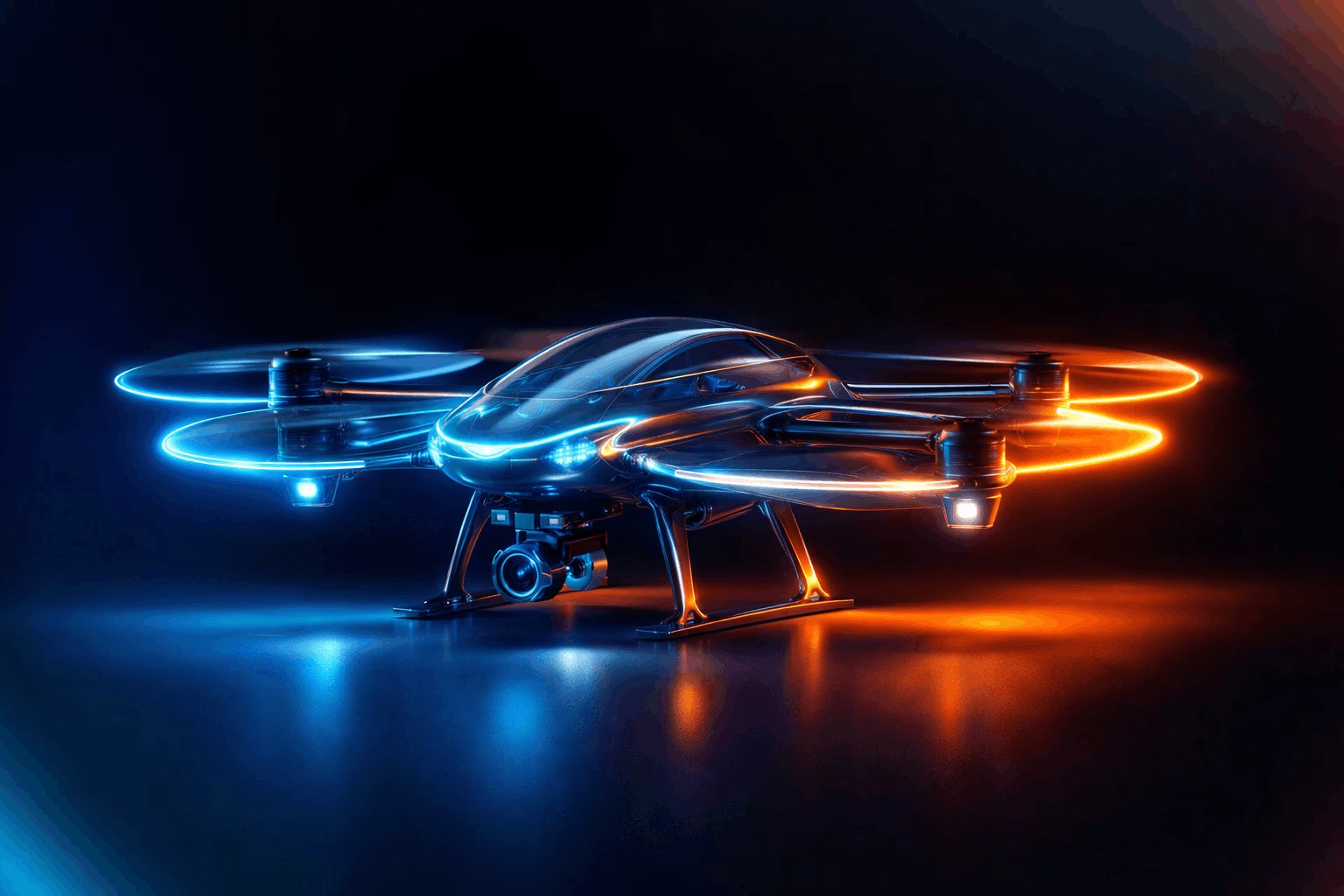
Deploying an embedded AI in industrial drones systematically collides with the reality of the field. Perception models display high success rates in the laboratory. However, degraded conditions reveal critical silent failures that neither the pilot nor the monitoring system detect in time. This article details the mechanisms of these failures, the reliability by prediction approach that allows them to be neutralized, and the new regulatory obligations imposed on system integrators.
When field conditions put drone AI perception to the test
Transitioning from a controlled environment to an industrial infrastructure exposes algorithms to unanticipated variables. Validated laboratory performance does not predict robustness in real-world deployment.
What "degraded conditions" concretely means for an industrial drone
Degraded conditions for the AI perception of an industrial drone refer to any gap between the deployment environment and the training dataset: direct backlight, high-frequency airframe vibrations, dust and suspended particles, configurations never seen by the model (OOD). In these situations, the model continues to predict with the same apparent confidence. It does not know that it does not know.
A roof inspection drone transitioning from a shaded area to full sunlight on a reflective metal surface, or an indoor mapping drone encountering a dense dust zone in a logistics warehouse—in both cases, the input data diverges from the training norm, which was often validated at over 98% in the laboratory. Yet, the model generates no alert. It continues to predict. This is precisely where the danger lies, and it is what the industry now refers to as the silent failure problem.
The 3 silent failure mechanisms that escape control
Three mechanisms cause these invisible errors during missions.
High-frequency vibrations: at a cruising speed of 15 m/s, motion blur alters the visual features that the model has learned to recognize. The degradation is subtle and not enough to be visible to the naked eye on an individual image, but sufficient for the model's predictions to drift silently. No warning system is triggered.
OOD situations in field conditions: faced with an atypical obstacle, a camera angle never covered during training, or an intense glare on a metallic surface, the model produces a prediction with high apparent confidence on a situation it has never seen. This is the issue of AI silent failure: the model makes a mistake without signaling it.
Progressive sensor drift: a lens dirty from industrial dust, a partially obstructed LiDAR sensor, or a calibration that drifts with thermal cycles (from 20°C indoors to 5°C outdoors). The model compensates up to an invisible breaking point.
In all 3 cases: no alert. The drone continues to operate as if its predictions were reliable.
The financial impact in a real industrial environment
The absence of an alert before failure has a direct and measurable cost. In April 2026, more than 100 Baidu robotaxis were stranded in traffic in Wuhan following a perception failure without a preventive alert, representing the first mass failure of an autonomous system fleet documented on this scale. In another telling case, Neolix halted its AV operations in Abu Dhabi due to a lack of proven perception reliability. These examples illustrate the exact same mechanism that threatens industrial drones in degraded conditions: the absence of an individual confidence signal before action.
In industrial robotics, field data demonstrates a 40% reduction in perception incidents and a 20% to 30% decrease in unplanned line stops with reliability by prediction (TrustalAI data).
Reliability by prediction for embedded perception: what changes
Aggregated monitoring is designed for a different problem: analyzing trends after execution. It evaluates the overall performance of the model over N predictions, identifies statistical drifts, and plans retraining cycles. Reliability by prediction addresses what aggregate monitoring does not see: individual inference, before action, in real time.
The operational difference is fundamental. Classic monitoring generates an alert at the end of the day or the following day when the incident has already occurred.
Reliability by prediction generates a confidence score in less than 100ms on each inference before the drone triggers a navigation, avoidance, or inspection action. In terms of OOD detection, aggregated monitoring can only identify an out-of-domain situation after accumulating sufficient data. The individual confidence score detects it at the precise prediction where it occurs.
And from a regulatory standpoint, aggregated metrics do not satisfy Art. 12 of the EU AI Act, which requires logs per individual inference, which the confidence score per prediction generates automatically.
A confidence score calculated before each navigation decision
Reliability by prediction measures, for each individual prediction of the embedded perception model, a real-time confidence score before the drone triggers an action. If the score is low, the system can alert the operator or suspend the action before any loss of control. If the score decreases progressively over a series of inferences, emerging instability is detected before aggregated metrics even shift.
The solution connects plug-and-play to the existing architecture, in a compatible black-box mode and without accessing model weights, without modifying the perception architecture, and without changing the navigation pipeline. Latence: 20ms in Edge computing, compatible with the real-time control loops of high-frequency industrial drones.
VEDECOM PoC results on real embedded perception data
The effectiveness of this approach is validated on real data. The PoC conducted with the VEDECOM Institute (Fadili et al., Intelligent Robotics and Control Engineering, 2025) on a sensor fusion architecture for autonomous vehicles demonstrated an -83% reduction in critical false positives, a -65% drop in position errors (from 1.44m to 0.51m) and -63% in orientation errors (from 6.28° to 2.35°). These results were achieved without retraining the client model, without modifying its architecture, and without accessing its weights.
The direct applicability to industrial drones is technical: same sensor fusion architecture (cameras, LiDAR, radar), same problem of OOD data in real deployment, same latency constraints in edge computing. What autonomous vehicles learned about embedded reliability, after billions invested and documented incidents, applies directly to the industrial drone fleets deployed today.
Industrial drones and EU AI Act: reliability as a regulatory obligation
The European legal framework transforms technical reliability into a strict legal obligation for manufacturers and system integrators.
Whenever an industrial drone operates in a space shared with human operators or controls critical infrastructure functions, it falls under the Annex III (high-risk) classification of the EU AI Act. For a system integrator, the Machinery Directive (Regulation 2023/1230) simultaneously dictates that legal liability for the reliability of the embedded perception directly falls upon them.
The regulation requires traceability inference by inference. Article 12 demands that each navigation decision be documented via automatically generated logs. Article 9 requires precise documentation of model limits, including the management of OOD situations and sensor drift. Article 10 requires the governance of training data with a representativeness of real deployment conditions, identified biases, and uncovered configurations.
Without a confidence score calculated per prediction, these obligations are technically impossible to satisfy: you cannot trace a decision without an individual inference log, nor document the limits of a model that is incapable of signaling when it leaves its domain of validity. The reliability by prediction layer generates these logs automatically, at each inference, without modifying the model or deployment processes. You deliver a drone that knows when it does not know and you have the confidence metrics to prove it to your customer.
Conclusion: the challenge of measurable reliability for industrial drones
Three findings are essential for any deployment of embedded AI on an industrial drone.
Validation in controlled conditions is not enough: the field systematically introduces OOD situations that the model does not signal, regardless of the accuracy achieved in the laboratory.
The risk window must be closed: the time gap between the onset of a silent failure and its detection is exactly what reliability by prediction closes by measuring the confidence of each individual inference before the action, in real time, before the incident.
Compliance requires documented proof: the EU AI Act (Annex III + Machinery Directive) now requires this reliability to be proven, not just stated in a specification sheet.
The 2-week PoC integrates the reliability layer onto the existing embedded perception model, without modifying it, without accessing its weights, without disrupting operations, and produces compliance logs under Art. 12 right from deployment.
FAQ: AI Reliability and Industrial Drone Perception
Why does an AI drone lose its bearings in wind or backlight?
Because these conditions create out-of-training-domain (OOD) situations that the perception model does not signal. The model was calibrated on data in stable conditions. Wind generates micro-movements that subtly alter each captured image. Direct backlight saturates entire areas of the sensor. In both cases, the input data moves statistically away from what the model has learned, but the model produces a prediction with high apparent confidence without signaling that it has left its domain of validity. Without an individual confidence score per inference, no signal is triggered before the incident.
Can we reinforce a drone's reliability without modifying the embedded model?
Yes. The reliability by prediction layer operates as an external, fully black-box compatible mode, without accessing network weights or retraining. The calculation is performed in less than 100ms (20ms in edge computing), compatible with real-time autonomous flight control loops. As demonstrated during the VEDECOM PoC (Fadili et al., 2025): -83% in critical false positives and -65% in position errors while keeping the initial perception model intact.
Do industrial drones fall within the scope of the EU AI Act?
Yes, whenever an industrial drone operates in a space shared with human operators or controls critical infrastructure functions. These systems fall under the Annex III (high-risk) classification of the EU AI Act. Two regulations apply simultaneously: the EU AI Act for the embedded AI software component (Art. 9, 10, 12) and the Machinery Directive (Regulation 2023/1230) for the physical system, which makes the integrator legally responsible for the overall safety of the delivered drone, including the reliability of its perception layer. Without a confidence score per prediction, Art. 9 and Art. 12 obligations are impossible to satisfy.
How does reliability by prediction redefine industrial drone operations?
Reliability by prediction transforms each inference of the embedded perception model into a measurable, documentability, and controllable decision before the drone acts. Under normal conditions (high score), the drone operates at full capacity autonomously. As soon as the score drops—detected OOD, sensor drift, out-of-domain condition—the system can alert the operator or suspend the action before any loss of control. This is not a restriction of the drone's capabilities, it is an extension of its operational reliability. Operations transition from the paradigm of "hoping the model works" to "measuring in real time that each decision is reliable before executing it." It is this shift that allows for the -83% reduction in critical false positives demonstrated on real data (VEDECOM PoC, Fadili et al., 2025).
Share
Related articles